CCS comes to SE London: climate solution or climate scam?
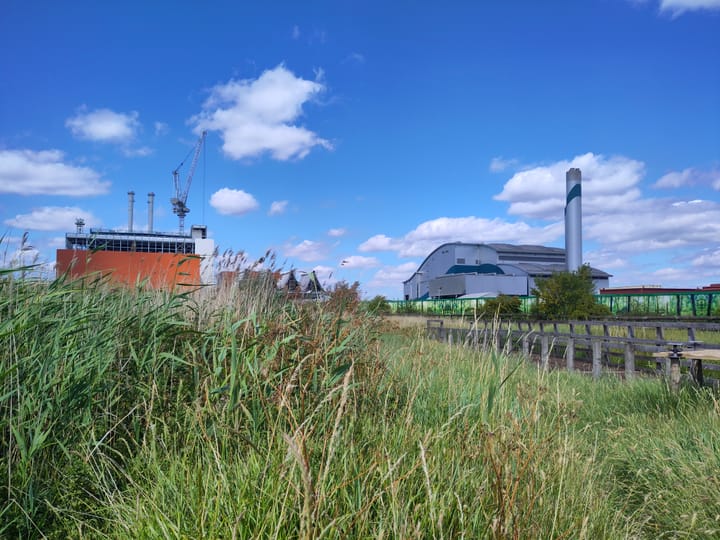
Campaigners brace for irreparable harm to Crossness nature reserve on Erith Marshes, while the government justifies it, declaring the UK's "urgent need for new CCS". But does its argument stack up?
When the Conservative government decided to pour money into carbon capture and storage (CCS) in 2023, UCL Professor of Earth System Science, Mark Maslin said bluntly "I am unaware of any CCS that works."
After the Labour government announced it would continue the £22bn investment, scientists wrote to the Energy Minister Ed Miliband, urging a review.
Stanford Professor Mark Z Jacobson, famous advocate of wind, water and solar power (WWS), has repeatedly shown that when upstream emissions and air pollution are taken into account, carbon capture "does more harm than good" and many others share his concerns.
But when waste firm Cory launched its "decarbonisation" plans in 2023, it told the public that carbon capture is "well-established and with successful examples already operational all over the world".
It implied that the transport and storage technologies which its project would need are also safe and well-established.
We examine the technology's record at each stage of the carbon capture, transport and storage process and what this could mean for Crossness nature reserve, workers, residents and future generations.
Sign-up for our free weekly newsletter - Salamander News in your inbox
Unproven with high risks at each stage
Carbon capture emerged from the oil industry - the technique has been used for decades for "enhanced oil recovery" (EOR), following which most of the carbon dioxide (CO2) returns to the atmosphere.
The oil industry has tried to repurpose the technique as a tool for capturing CO2 emissions from power plants and industry, but its performance has been consistently poor, far below the 95% capture rate that Cory says it will achieve.
The Institute for Energy Economics points to CCS' "poor track record", while even Chevron's Gorgon project in Western Australia, billed as a world-leading example of CCS, is failing to deliver.
There are risks beyond poor performance. The carbon capture process planned for Riverside 1 and 2 will use amine-based chemical solvents to absorb CO2 from the flue gases.
These solvents degrade in use, creating compounds known to be carcinogenic even in very low concentrations, which are difficult to monitor outside a laboratory.
The chemical solvent will be coming in and out of the Crossness site, used and refreshed, posing an ongoing risk to people, plant and animal life in the area.
The process requires energy to first capture the CO2 then reclaim the solvent, separate out the CO2 and send the remaining flue gases up the chimney.
This significant energy demand will reduce the amount of power that the incinerators feed to the grid.
Critics of CCS point out that this reduction in baseload power (and the emissions created by generating electricity to compensate for it) is not accounted for in CCS figures.
The transport stage of the process presents a different set of challenges and has been described as "uniquely dangerous".
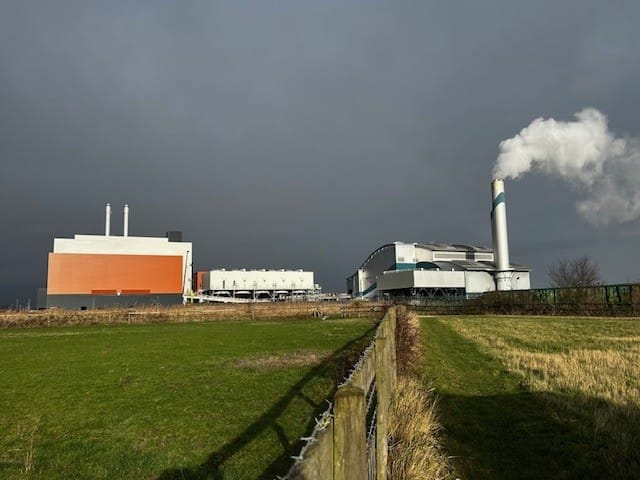
Cory plan to store captured CO2 on-site in six storage vessels, 20m in diameter, then pipe it into tankers and ship it down the Thames to the (still unbuilt) Viking carbon capture hub at the port of Theddlethorpe in Lincolnshire.
The firm announced that they have agreed this plan with oil companies Harbour Energy and BP, and Associated British Ports.
After decanting the CO2 at Theddlethorpe, they plan to use a repurposed gas pipeline to take the compressed carbon dioxide hundreds of kilometres out under the North Sea to disposal sites at the Viking field.
Concerns have been raised about the repurposing of gas pipelines - methane and CO2 have different chemical and physical properties and are transported at different pressures, and the UK has no engineering expertise in the transport of condensed CO2.
There is also a risk of corrosion from contaminants in the captured CO2.
The Ferret reports concerns about the repurposing of gas pipelines for transporting CO2 from Scotland's central belt across Aberdeenshire, and the potential dangers of CO2 leaks.
In 2020, a leak from a carbon dioxide pipeline caused a terrifying accident in the small town of Satartia, Mississippi.
Dozens of people collapsed, unconscious. Cars engines froze and ambulances were unable to get to the scene. Some of the victims suffered long-term neurological damage.
Carolyn Raffensperger, executive director of the US Science and Environment Health Network told Amy Westervelt and Drilled that the areas around the pipelines used to transport condensed carbon dioxide from oil fields to other oil fields, for EOR or for storage, are termed "kill zones" or "fatality zones".
Carbon pipelines are "uniquely dangerous and underregulated,” she says.
If leaks occur from Cory's storage vessels on Erith marshes, from its pipelines or from the storage tanks of its ships, the consequences for workers, for the public and for nature could be catastrophic.
Sign-up for our free weekly newsletter - Salamander News in your inbox
The final part of the process, undersea storage, is unproven, with few trials across the world.
The UK government has already sold off licences for storage areas across the North Sea, allowing oil and gas firms to start drilling for surveys.
Norway has led the field in trials of undersea storage, but its two pilot sites at Sleipner and Snohvit were not a success.
Despite intense planning and monitoring, "conditions began deviating dramatically from design plans only about 18 months into CO2 injections".
Grant Hauber of the Institute of Energy Economics and Financial Analysis (IEEFA) warns: "Every project site has unique geology .. (and) any information obtained about that place is only a snapshot in time.
"The Earth moves and strata can change."
There are further concerns about the disruption and pollution that this new wave of industrialisation of the North Sea, its effect on marine life and on the ocean blue carbon cycle.
For Cory, failure of undersea storage would mean a failure of its CCS project.
The impact on current and future generations would be not only an increase in greenhouse gas emissions, but the high financial costs from attempts to monitor and mitigate leakage.
Inevitably, these risks will prove unacceptable to private investors and will need to be underwritten by the UK taxpayer.
Taxpayer funding and sales of carbon credits
At one of the public hearings into Cory' CCS proposal, campaigners asked how the project would be funded.
Cory's consultant advised that the firm expect to receive financial support from the government that would eventually cover up to 50% of construction costs and some operational costs.
In addition, Cory expects to receive an income stream from selling carbon credits to "third party purchasers such as international tech companies, banks or oil and gas majors for the purposes of carbon offsetting" using the government's Emissions Trading Scheme (ETS).
This depends on an argument about the carbon accounting of organic materials that has been challenged by many climate scientists.
Cory point out that some of the carbon dioxide will capture is "biogenic" - it is produced from burning organic materials such as cardboard or paper.
Along with others in the Energy from Waste (EfW) industry, they treat these emissions as "carbon neutral" in their reporting, on the basis that somewhere in the world, plants or trees regrow to take up the equivalent amount of carbon dioxide.
Cory then argue that once they have carbon capture, they will have taken themselves into carbon negative territory.
The income stream depends on low recycling rates continuing across London boroughs.
Climate scientists point to the close connections between the fossil fuel industry and CCS, and the industry's lobbying of governments for the "climate solution".
531 CCS lobbyists attended the most recent COP30 in Belem, representing government and corporate oil interests, while Dr Jonathan Foley of Project Drawdown calls CCS "a fig leaf for Big Oil", arguing that its role is to give oil and gas companies (and incinerators), a social licence to continue to pollute.
If Cory's plans are followed through, they will cause irreparable harm to the protected Crossness nature reserve, and destroy two separate kinds of natural carbon sink - grazing marshland along the Thames, and "blue" carbon which is held within marine ecosystems in the North Sea.
The process of carbon capture, transport and storage will create carbon emissions from start to finish, and increase air pollution.
In the name of climate action, it will inefficiently, at high cost to the UK taxpayer, and with ongoing risk to future generations of leakage and rupture, attempt to replicate natural processes which remove carbon dioxide from the air.
It feels as if the UK government has passed through Alice's Looking Glass and learnt to believe as many as six impossible things before breakfast.
A spokesperson for Cory said: "By capturing both biogenic and fossil emissions from waste, carbon capture plays an important role in decarbonising hard-to-abate sectors of the economy.
"The Committee on Climate Change has recognised this capability as essential for the UK to meet its net zero target.
"Cory’s carbon capture and storage (CCS) project was granted development consent and designated a Nationally Significant Infrastructure Project by the UK government following the submission of extensive planning, environmental and engineering evidence, and a six‑month public examination."
Sign-up for our free weekly newsletter - Salamander News in your inbox